Oracle Fusion, a term that is buzzing around already for years and getting a more mythical sound to it every year it is discussed. Fusion should be the answer to a lot of questions and it is coming, it is coming soon. Even though Oracle is promoting it and has been releasing a lot of buzz around it some people are getting tired and are getting confused. The expectation was that Oracle would provide a complete new stack in one go and that it would branded in the same way as we have seen with 11G and 12G. I have been asked a couple of times by people within the company to talk to them on what the future of Oracle will be from a technology point of view so I decided it would be a smart move to start blogging about it and provide all of you an insight into what I have found and what I think will be the future of Oracle from this point of view.
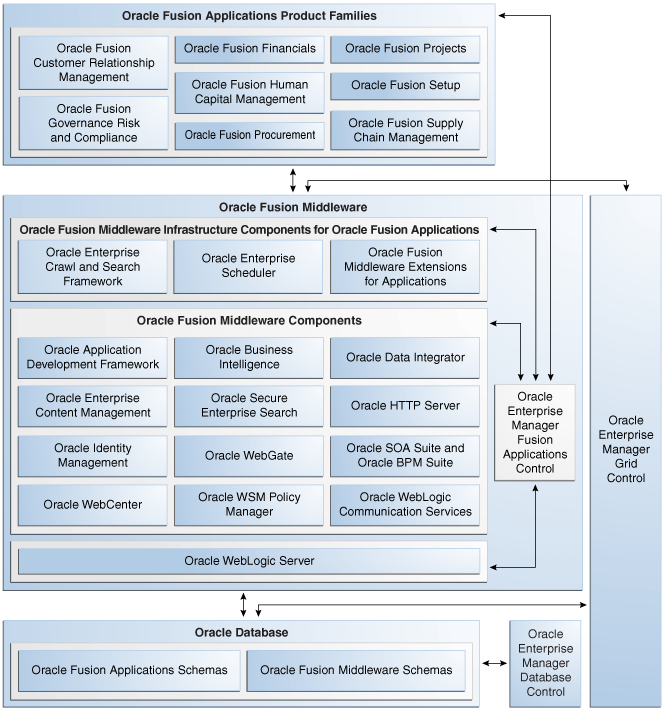
However, Oracle is releasing bits and parts of the Fusion stack, from a marketing purpose you can see this as smart, a buzz is created, or you can see this as a weakness, they start talking about something which is lacking shape at the moment they started talking about it. What a lot of people do not realize is that there is a lot Fusion out there, released possibly below the radar or people do not get the picture that it is part of the new Fusion stack. The below diagram holds a high level design of the Oracle eBS Fusion stack coming up from the database up till the functional modules. The picture is coming from the Oracle manual Oracle Fusion Applications Administrator’s Guide 11g Release 1 (11.1.1.5.0) launched as draft in April 2011. Even though it is confidential officially some people have released it to the public. Thanks to the people at
orastudy.com we are able to take a peak in the draft version, you can have a look at the manual at Scribd.com and you can read it as a embedded document from
Scribd.com at the end of this blogpost.
Looking at the picture below you can get a glimpse of the stack which to which Oracle refers to as the Fusion stack. At the top we have the Oracle Fusion Application Product Families who consist out of a lot of Oracle e-Business Suite applications and modules and will be the new core of the Oracle Fusion applications. You can see the Oracle Fusion Middleware stack, I will be spending some blogpost in the upcoming time on them to explain them in more detail, you can see that most of this is based upon the Oracle Weblogic Server which is not a surprise to most of you.
From a application point of view Oracle is dividing the applications in a couple of clustered which I will blog about more in the upcoming posts. Below you can see them in a slide from a Oracle presentation. To name them; Oracle Fusion Financial Management, Oracle Fusion Human Capital Management, Oracle Fusion Supply Chain Management, Oracle Fusion Project Portfolio Management, Oracle Fusion Procurement, Oracle Fusion Customer Relation Management and Oracle Fusion GRC or in full Oracle Fusion Governance, Risk and Compliancy.
As you can notice a great place is reserved in the stack for Oracle Enterprise Manager, this is a great part of the monitoring and maintenance stack from Oracle. What is missing in this picture is the hardware component of Oracle Enterprise Manager which has been added after the acquisition of Sun Microsystems and also the creation of the ExaData and ExaLogic machines. Oracle is now able to monitor all parts of the stack which includes both hardware and software.
e14496