Wednesday, February 28, 2007

The new battlefield

Robots are getting smaller and smaller by the day. The first robots in SiFi movies where enormous, they where displayed as mechanical monsters who where operated by a evil genius who wanted to destroy the world or takeover the world. Asimov, also a SiFi writer, wrote the laws of robotics who stated that a robot should never harm a human not even if the operator intended it to harm a person.

I Still believe that the Asimov laws are to be followed however today we see robots who control borders and military facilities and who are equipped with machine guns and other weapons. In basic there is nothing wrong with a robot walking around a compound and leaving the operator in a warm and dry environment however at the moment that you arm them there is a difference. At least this is in my opinion.

Robots as they where displayed in the first SiFi movies have never become reality, the first robots developed where big however not as big as in the movies and now the trend is to make them smaller and smaller.

The latest robot in the small-robot series comes from France and is developed by SilMach and received a price from the France department of defence, the Prix Science et Defence. The Libellule is 3 centimeters long and has a weight of 120mg where 20mg go's to the wings. As with many of the small robots the battery lifetime is the main problem.

That the France department of defence has honored the researchers with a price indicates that they have a interest in small robots. This will most likely be the future of the battlefield in the upcoming years. Small robots who might work alone or in a cluster will scan the battlefield on a ground level or a just above ground level. At higher altitudes robots like the Predator will circle and give a bigger picture to the commanders while at the same moment other robots will scan for mines and IED's or patrol the perimeter of airfields and might even be used for House to House combat.

In the future there will be a big difference in the way how troops will behave in the battlefield, the difference will be between those countries who have the money to develop those kinds of new battle equipment and those who do not have the resources. If a conflict like Somalia will ever raise again it could very well be that the troops of the warlords will not even see the enemy troops from the western world. It could very well be that if a war like that flames up again in 20 years that the troops will send in robots who are controlled from a main control room aboard a ship a couple of kilometers out of the coast and which is well defended by a fleet of escort ships who will protect it against all possible attacks.

As I already stated I am against arming robots, there is a difference between standing on a battle field and looking at the other man before you decide to pull the trigger and sitting in a save environment between a screen in an airco controlled operating room. In my opinion the operator will decide to open fire a lot quicker than the man on the ground and even do all the systems are there to give the operator a clean and open view of the battlefield it can not make a decision like the man on the ground who can hear, see and smell everything the same way as his opponent.

I do not think it is a bad thing to use robots to clear mines, patrol airfields and do all kinds of recognisance tasks, I even have the feeling they might be better at this than a human but having them engage in a real war and in real combat is not the way to go.... at least not at this moment and not with the Asimov law in place. Thank god for the Asimov law..... If countries should have large robot armies the step to go to war would be so much smaller and I think the collateral damage, the dead under civilians should be a lot bigger.

When a President or Government has to send there own young man and woman out there and there is change they might end up in a body bag they have one more point to consider. If only damaged machines should come back home that would not even be a point of discussion when deciding to go to war. s

Tuesday, February 27, 2007

Trip to Prague


As you might know I have a new job... Thursday I will start as a Oracle Consultant at my new employer. This has given me the opportunity to travel to Prague for a couple of days. This is also the reason why I have not been updating this weblog for some time now.. If you would like to view the photos of my Prague trip take a look at flickr

Wednesday, February 14, 2007

Fire robot.


Agent 007 is a mighty versatile fellow, but he would have to take backseat to agents being trained at Washington University in St. Louis.

Computer scientist engineers here are using wireless sensor networks that employ software agents that so far have been able to navigate a robot safely through a simulated fire and spot a simulated fire by seeking out heat. Once the agent locates the fire, it clones itself - try that, James Bond -- creating a ring of software around the fire. A "fireman" can then communicate with this multifaceted agent through a personal digital assistant and learn where the fire is and how intense it is. Should the fire expand, the agents clone again and maintain the ring - an entirely different "ring of fire."

Agents in computer lingo are specialized pieces of code that are self-contained and mobile. Wireless sensor networks are made up of tiny computers that can fit in the palm of a hand. They can run on simple AA batteries, sport an antenna and a sensor with a specialized duty of sensing the environment -- temperature, magnetism, sound, humidity, for instance.

Gruia-Catalin Roman, Ph.D., the Harold B. and Adelaide G. Welge Professor of Computer Science and department chair, envisioned a new kind of software architecture to support applications targeted to the sensor network environment. Chenyang Lu, Ph.D., Washington University assistant professor of computer science and engineering and Roman's doctoral student Chien-Liang Fok, and Roman developed a middleware - a special kind of software -- called Agilla, which enables agents to move across the sensor network and between sensor networks connected via the Internet and to clone themselves, thus forming complex communities of cooperating agents.

This approach to the development of sensor network applications is novel and offers an unprecedented level of flexibility. It also permits multiple applications to co-exist over the same basic hardware in response to changing needs.

Roman believes that wireless sensor networks are poised to explode upon the world stage, similar to the way that the Internet took off after the creation of the World Wide Web.

"What researchers are banking on is that sensor networks will be so cheap to make that they can be employed on a very large scale," said Roman, who directs Washington University's Mobile Computing Laboratory. "This way you can spread hundreds and thousands of them around gathering data and communicating."

Imagine a farmer wanting to get soil data - temperature, or Ph - over hundreds of acres with slightly varying soil types. Instead of painstakingly physically taking measurements - being a farmer 'outstanding in his field' -- in theory, he could send a software agent with Ph sensing capabilities to a particular sensor network, have the Ph agent clone itself and gather the data over hundreds of acres, then transfer itself onto another sensor network on the Internet and send its data back to the farmer's office. That's not Old MacDonald's farm.

Similarly, a manufacturer might want to safeguard containers in a warehouse. A sensor network can be put in place on the containers that communicates with each other, alerting an alarm should, say, light be sensed, or a vibration. Again, the manufacturer can remain in his office and communicate with the network with a PDA.

"This is fascinating software, and this technology is opening up, and we have no idea where it's going to go, " Roman said. "Right now, wireless sensor networks are allowing us to explore the future."

One of the key features of Agilla software is its flexibility. For instance, in the fire-simulation study, the networks allow for both simulation of fire and tracking of the fire. Agilla is considered a major breakthrough in the field of wireless sensor networks and lays the foundation for rapidly developing applications.

The Aristo robot and navigation experiment are courtesy of Burchan Bayazit, Ph.D., Washington University assistant professor of computer science and engineering , and his graduate student Nuzhet Atay, of the University's Media & Machines Laboratory.

Crash during landing.

After some searching I finally found some pictures online of a unfortunate landing of my father in law. Here you can see 2 pictures of the landing and one a couple of hours after the landing. According to the story he told me the approach went without any problem, landing gear came out and gave all green however at the moment of touchdown one of the landing gears turned out to be not secured. One of the pins that should have secured the landing gear malfunctioned which resulted in the landing gear to be pushed back into the place.

As you can see on the pictures the result was that the plane tilted. Due to the fact they where able to reverse thrust of one of the engines and hard steering to one side the co-pilot and he where able to prevent the plane from performing a half turn at full speed on the runway.

The end results were some bruises and shocked passengers and a damaged plane. This all happened somewhere in march 1989 at the airport of Geneva.


Monday, February 12, 2007

Fly-by-Sight Microrobots


The fly's eye is one of the most well-organized units of visual optics in the world. But is it possible to understand how it works and reproduce it on board neuromimetic robots that could navigate in complete safety? This is the two-part question that Nicolas Franceschini's research team is trying to answer.

The more Nicolas Franceschini tells you about the research he's directing at the helm of the biorobotics department of the Movement and Perception laboratory in Marseille,1 the more you get the urge to stare out the window to watch flies. It's not that there's no buzz in the conversation of this expert in insect sight; quite the contrary. You listen to him enthusing about the amazing behavior of these “agile airships” that he's been studying for over thirty years and that today enable him to design “artificial flying creatures.” These are so efficient, that they make planes and helicopters pale with envy. You just can't help looking out to marvel at the arabesques of these insects buzzing past at high speeds without ever crashing.

But what's so special about the fly's eyes, that have made these insects champion stunt fliers for over 100 million years? First of all, answers Franceschini, “they're totally panoramic, so they can take in the whole of their surroundings.” Futhermore, the fly's “cockpit” contains about 1 million neurons powered by electric signals from the 48,000 photoreceptor cells that make up the mosaic of the retina. The neuron network processes these signals and sends the “electric flight controls” to 18 pairs of motor muscles that adjust the amplitude, frequency, and angle of attack of the wings in real time. This is what lets the fly change direction rapidly, escape from its predators, detect and follow a sexual partner with single-minded determination. The best robots produced today are nowhere close to replicating this kind of precision. Having deciphered how the movement-detecting neurons work, using microelectrodes and special microscopes, the team in Marseille managed to transcribe the main functions into miniature optoelectronic circuits which, 15 years ago, gave sight to non-flying robots that could avoid obstacles without help.

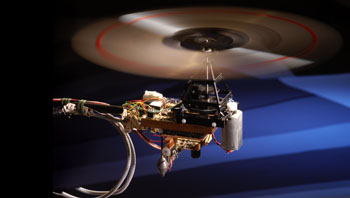
More recently, Franceschini discovered that the insect's retina, which is normally extremely stable, starts to vibrate actively in flight. To understand why this happens, the researchers did a computer simulation of the mechanism, reproduced it technologically and integrated it into a 100-gram twin-engine airship they called Oscar.

“The retina microscanning process allows the fly to keep its eye fixed on a target with a fine-tuning 40 times better than if the retina remained static,” says Franceschini. He's delighted that Oscar never gets flummoxed, in spite of all the devious ways that its designers find to torture it in their experiments (crosswinds, shocks to the fuselage, etc.). Its “vibrating eye,” connected to an electronic movement detector neuron, locks its sight onto the target “like a male fly chasing a female.” This implies possibilities to one day replace both the costly and heavy radars and energy hungry Lidars2 used on some helicopters to locate high voltage cables, by an anti-collision system derived from the fly's eye, that emits no radiation, is inexpensive, and featherweight.

But there's another flying insect-robot with “visuomotor intelligence,” that also has a bright industrial future.

Octave, a 100-gram helicopter, uses an eye in its underbelly that points earthwards, and is directly inspired by the fly's flight-control mechanisms. This allows it to take off and follow a slope at a speed of three meters per second, react to a head wind and land automatically, without any help from avionics (speedometer, altimeter, variometer) but using an “optic flow regulator.”3 This masterpiece could eventually be used as an automatic pilot on spacecraft and aircraft, and even on submarines observing the ocean floor.

These CNRS-patented results, which are at the crossroads of ethology, integrative neuroscience, and robotics do two things at once: They enrich our knowledge of living beings while giving rise to bionic machines inspired by age-old natural principles.

1. CNRS / Université de la Méditerranée joint lab.
The team received the prize “La Recherche 2005.”
2. For Light Detection And Ranging: A detector that emits a laser beam and receives the echo back.
3. “Optic flow” refers to the scrolling of the retinal image created by movement.
The optic flow regulator keeps the optic flow constant by acting on the flying height.

This article is originally done by Philippe Testard-Vaillant for CNRS magazine.

Friday, February 09, 2007

soft and mobile robots.

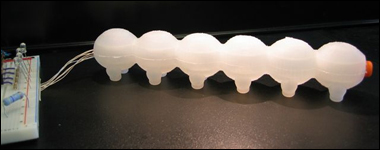
Tufts University biologists and engineers have launched an initiative to build robots with pliable parts — from the body down to the electronic components and wiring.

The soft-sided robots will be able to collapse into small packages and spring back to form as well as climb textured surfaces and burrow into confined spaces.

Flexible robots could do everything from explore inside a person's body to help doctors make a medical diagnosis, to examine industrial pipelines for damage. They could also be used to climb through hazardous zones such as inside a nuclear reactor or minefield, or repair delicate solar panels on space vehicles.

"In the next year or so we will be building machines that are squishy and can crawl," said Barry Trimmer, who, with David Kaplan, co-directs the Biomimetic Technologies for Soft-bodied Robots project.

Trimmer has spent years studying the nervous systems of caterpillars and silkworms to better understand how the creatures control their undulating motions with very simple brains.

He has identified individual cells in the brain responsible for certain movements.

Because the animals are flexible and lack skeletons, their movement is less limited than that of animals with skeletal systems. The human elbow, for example, can only bend in two directions.

Many rigid robots have similar kinds of joints.

But caterpillars can move in many directions, and don't need much of neural power to do it. Their muscles respond to simple signals from the brain, yet have the ability to twist and contort to move up a tree branch or reach under a leaf.

The idea is to build a robotic control system that mimics the nervous system and muscle power of the caterpillar.

Kaplan's department will conduct research on the soft materials meant to make up the body and electronics. Kaplan is applying genetic engineering and nanotechnology to produce flexible materials as tough as spider silk.

In the end, the team hopes to create "A robot that you can pick up and crumple into a ball in your hand, let it go, and watch it walk away," said Trimmer.

Having robots that lack rigid parts is a goal shared by other researchers, said professor Ian Walker of Clemson University in Clemson, S.C. But a lack of metal could mean a lack of power.

"Other groups, including our own in developing 'trunk and tentacle' robots, have aimed at producing completely soft robots, but have had to settle for having at least some rigid parts," he said.

"It will be interesting to see if they can get enough strength from the materials and components they plan to use. This has been a key issue."

Wednesday, January 31, 2007

Not many posts?

Not many posts in the past couple of weeks. Is this the feeling you get? You can be quite right about this. I have been on a short, hiking with my girlfriend at La-Palma. We have been waling the mountains of La-Palma, been sleeping in the sun, relaxing and we have found some time to bring a visit to Instituto de Astrofísica de Canarias.

Also in the week after the trip I still had a week of holidays left which I spend for looking for a new job. This was with some success which resulted in the fact that I have resigned from my current job as Technical Oracle Consultant at Canon Europe and I have accepted a new job at an Oracle consultancy firm as a consultant.

I have had a splendid time at Canon Europe and I was able to be part of the Canon Tri.Can and travel around in Europe from time to time. However I have decided that it is time to make a change as my current team is been divided and we will no longer be able to work as a single team, we will become some sort of virtual team under different managers and I feel I will not be able to feel at home anymore when this change comes in places. To read more about the Tri.Can project you can turn to one of the contracting companies their website to find out more.

Tuesday, January 30, 2007

Inventory Management in space.

Inventory Management is always a big issue, what do we have on stock, what do we need to order, what item is located where. This is the case for major companies, a simple household and even for the international space station ISS . Due to the volume of articles onboard Station, and the fact that Station will be on orbit continuously for at least 15 years, the need arises for a system of tracking the location and status of items that have been stored on board. The Inventory Management System (IMS) fulfills that purpose.

This application is based on the use of barcode labels. Starting in March 2007, the old barcode reader terminals will be replaced by PDAs. These PDAs will be equipped with a barcode reader and will be connected to the IMS via a wireless network.

In the near future, PDAs will start being used as integrated components of the IMS.

A special application, known as the PDA Depressurisation Program (PDP) and conceived by the astronaut Thomas Reiter, has been developed by ESA to compute the ‘egress time’, – the time that is left before having to abandon the ISS in the event of depressurisation.

This application, tested for usability by Reiter during his long duration mission – from July to December 2006 – is currently undergoing qualification by NASA and will become part of the standard set of software packages loaded on each astronaut PDA.

PDAs have been investigated as alternative or complementary platforms for some of the applications currently running on the ISS laptops. The idea is to use a PDA in those situations where a laptop might be inconvenient because it is too big or cumbersome.

An example of laptop to PDA conversion, developed by industry using ESA research and development funding, is the porting of the ESA/NASA International Procedure Viewer (IPV) application. In this type of conversion, the critical factor is adapting the laptop based user interface to a new platform where the available screen area is significantly smaller.

Another area of research is the use of the PDA as a voice or speech processing platform. Combined with wireless communication, PDAs could become suitable devices for crew-to-crew communication (VOIP applications) and crew-to-system communication (speech synthesis and speech recognition One limitation for applications employing voice sounds for either input or output is the noise that is always present on board the ISS, most of which is generated by the ventilation system. The PDA Depressurization Program uses speech synthesis to notify the crew members about the time remaining before egress. However, ambient sound is not an issue for this application because, if depressurization occurs, the ventilation system is automatically switched off as safety measure.

Hubble primary camera offline


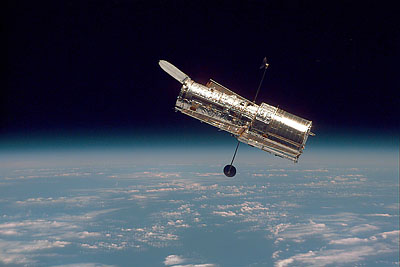
The Hubble Space Telescope’s primary camera is offline, with some science capabilities likely lost for good, NASA officials said Monday.

An electrical short in the backup system for Hubble’s Advanced Camera for Surveys (ACS) pushed the space telescope into a protective “safe mode” over the weekend and prompted the formation of an Anomaly Investigation Board on Monday, NASA officials said.

The incident, the third since June to hobble Hubble’s ACS camera, occurred at 7:34 a.m. EST (1234 GMT) on Jan. 27. Engineers managed to switch the space telescope back to normal operations, with the exception of the ACS instrument, by Sunday and hope to resume science observations with the observatory’s remaining instruments later this week.

NASA has convened an Anomaly Review Board to go over Hubble’s latest malfunction, the results of which are expected to be presented by March 2.

“Obviously, we are very disappointed by this latest event because of the popularity of the ACS instrument with astronomers,” NASA’s Preston Burch, Hubble program manager at the Goddard Space Flight Center (GSFC) in Greenbelt, Maryland, told reporters today in a teleconference.

It was Hubble’s ACS camera’s wide field channel, for example, that allowed astronomers to generate Hubble’s Ultra Deep Field – the deepest view into the universe to date. But that ACS channel, and a high-resolution channel used to study stars surrounded by planet-forming material, are likely lost since the latest glitch has cut off power to their systems, Hubble managers said.

“We’re not optimistic at all that those will be restored,” said David Leckrone, NASA’s senior project scientist for Hubble at the GSFC. “The saving grace here is that we have a superb new wide field camera coming along that was originally designed, in fact, to be a back up for ACS in case ACS failed. It was designed to work in tandem with ACS if [it] was full alive.”

That new camera – known as Wide Field Camera 3 – is due to be installed at Hubble during NASA’s last space shuttle flight to the observatory in September 2008.

Hubble engineers hope they will be able to restore partial ACS science capability with its third feature – the Solar Blind channel used recently to study auroras on Jupiter and Saturn – by February to aid NASA’s New Horizons mission, which is due to make a close flyby of Jupiter on Feb. 28.

“As soon as we’re confident that everyone has done their homework on that, we could very have the Solar Blind operating by the end of February,” Burch said. “That would be the hope.”

Hubble’s other, non-ACS instruments – the Field Planetary Camera 2, Near Infrared Camera Multi-Object Spectrograph, and the Fine Guidance Sensors – are unaffected by the recent glitch.

Hubble’s camera troubles

Hubble’s ACS camera has been working on its backup, or Side B, system since the instrument’s primary Side A electronics encountered a malfunction in June 2006. An electronics hiccup a few months later in September again knocked the camera offline, but the system recovered a short time later.

NASA Hubble managers said the most recent glitch is a completely isolated incident and is not connected to the earlier problems.

“It’s very different,” Burch said, adding that the current anomaly’s signature is very different from those seen last year.

Hubble managers have also prepared about six observation surveys that do not require the ACS camera just in case the finicky instrument went offline. Those research projects will now be implemented while the camera is unavailable.

The ACS anomaly comes just two months before the instrument’s projected five-year warranty expired, Hubble managers said. Spacewalking astronauts installed the camera on March 7, 2002 during NASA’s STS-109 mission aboard the Columbia orbiter. Launched in 1990, the Hubble Space Telescope has been billed as one of the most valuable astronomical instruments of all time and is the product of a partnership between NASA and the European Space Agency.

“It’s certainly been an astounding success as an instrument,” Rick Howard, acting director of NASA’s Astrophysics Division at NASA’s headquarters in Washington, D.C., adding that the camera met about all of its initial science objectives before its recent failure.

Because of the ACS camera’s hard-to-reach location on Hubble and the already packed five-spacewalk schedule of NASA’s final servicing mission to Hubble – Servicing Mission 4 slated to launch in September 2008 – adding a new and complicated repair job to the spaceflight is not an attractive option, Burch said.

“Servicing Mission 4 is a very full mission with installing new batteries and gyroscopes, installing one of the fine guidance sensors and two new instruments,” Burch said, adding that the initial plan carries no ACS-related additions to the upcoming Hubble overhaul.

Leckrone said that the new instruments to be grafted into Hubble during Servicing Mission 4 (SM-4) will almost completely restore the telescope’s lost ACS abilities, though the new Wide Field Camera 3 will take longer to generate its predecessor’s stunning views of the universe.

“The successful completion of SM-4 and insertion of Wide Field Camera 3 will take us fully back to not only where we are now, but where we want [Hubble] to be in the future,” Leckrone said.

Thursday, January 11, 2007

Concurrent request in Oracle

Concurrent request in Oracle can be compared with Cron Jobs under UNIX. They give you the possibility to schedule programs to run once or periodically. The power of a concurrent request is that it will run inside your database application. The power of this is that you can do all your coding and scheduling inside your database without the need to create a external program which will call your database application and perform the requested tasks.

Concurrent requests are often used to periodically check things, clean-up stuff, export information or forward data. To create and schedule a concurrent request in Oracle Applications you basically need to complete those five steps:

(1) Create your code.
(2) Define a Concurrent Program Executable.
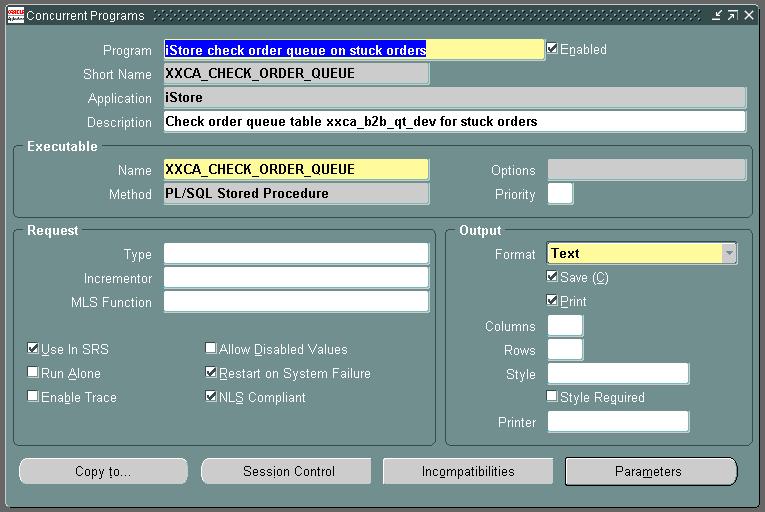
(3) Define a Concurrent Program.
(4) Attach to a Request Group.
(5) Schedule the Concurrent Request.

(1) Creating code:
As an example we will use a PL/SQL concurrent request, you can use other languages such as Java to create code, which can be called by a concurrent request however in this example we will only discuss a PL/SQL concurrent request.

When creating a PL/SQL procedure you can create this as you would normally create a stored procedure. The only difference is that you will need to create 2 OUT parameters, namely ERRBUF and RETCODE. This is required if you want to run the procedure as a concurrent request:

Example:

PROCEDURE mail_stuck_orders(errbuf out varchar2, retcode out number)
IS
……….

For more information about how to create a concurrent request you can refer to the Oracle Applications Developer’s guide.


(2) Define a Concurrent Program Executable.
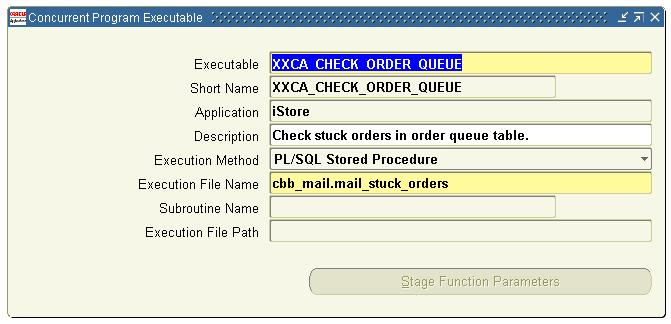
To be able to use the code as a concurrent program you first have to define your code as a executable code in Oracle Applications. To do so select the “System Administrator” responsibility and go to the following menu: “Concurrent” : “Program” : “Executable”. As an example we are creating a program that will check if orders placed using Oracle iStore are stuck in a queue.

The minimal required information for defining a Concurrent Program Executable are:

- Executable:
Enter a name for your concurrent program executable. In the Concurrent Programs window, you assign this name to a concurrent program to associate your concurrent program with your executable logic.

- Short name:
Enter a short name for your concurrent program executable.

- Application:
The concurrent managers use the application to determine in which directory structure to look for your execution file.

- Execution Method:
The possible execution methods are:
* Host: The execution file is a host script.
* Oracle Reports: The execution file is an Oracle Reports file.
* PL/SQL Stored Procedure: The execution file is a PL/SQL stored procedure.
* Java Stored Procedure: The execution file is a Java stored procedure.
* Java Concurrent Program: The execution file is a program written in Java.
* Multi Language Function: The execution file is a function (MLS function) that supports running concurrent programs in multiple languages.
* SQL*Loader: The execution file is a SQL script.
* SQL*Plus: The execution file is a SQL*Plus script.
* Spawned: The execution file is a C or Pro*C program.
* Immediate: The execution file is a program written to run as a subroutine of the concurrent manager. We recommend against defining new immediate concurrent programs, and suggest you use either a PL/SQL Stored Procedure or a Spawned C Program instead.
* Request Set Stage Function: PL/SQL Stored Function that can be uesd to calculate the completion statuses of request set stages.

- Execution File Name:
Enter the operating system name of your execution file. Some operating systems are case sensitive, so the name entered here should match the file name exactly. Do not include spaces or periods (.) in the execution file name, unless the execution method is PL/SQL stored procedure or Request Set Stage Function. The maximum size of an execution file name is 60 characters.

An option are the following 2 fields:

- Subroutine Name:
Enter the name of your C or Pro*C program subroutine here. Do not use spaces or periods (.) in this field. Only immediate programs or spawned programs using the Unified C API use the subroutine field. We recommend against defining new immediate concurrent programs, and suggest you use either a PL/SQL Stored Procedure or a Spawned C Program instead.

- Stage Function Parameters: The Stage Function Parameters button opens a window that allows you to enter parameters for the Request Set Stage Function. This button is only enabled when you select Request Set Stage Function as your Execution Method.


(3)Define a Concurrent Program.
The following step is to create a program and link this to the newly created executable. The following fields and options are available when defining a Concurrent Program:

- Concurrent Programs Block:
The combination of application name plus program name uniquely identifies your concurrent program.

- Program:
You see this longer, more descriptive name when you view your requests in the Requests window. If this concurrent program runs through Standard Request Submission, you see this name in the Submit Requests window when you run this program.

- Short Name:
Enter a brief name that Oracle Applications can use to associate your concurrent program with a concurrent program executable.

- Application:
The program's application determines what ORACLE username your program runs in and where to place the log and output files.

- Enabled:
Indicate whether users should be able to submit requests to run this program and the concurrent managers should be able to run your program. Disabled programs do not show up in users' lists, and do not appear in any concurrent manager queues. You cannot delete a concurrent program because its information helps to provide an audit trail.

Executable.

- Name:
Select the concurrent program executable that can run your program. You define the executable using the Concurrent Program Executables window. You can define multiple concurrent programs using the same concurrent program executable. See: Concurrent Program Executables.

- Options:
Some execution methods, such as Oracle Reports, support additional execution options or parameters. You can enter such options in this field. The syntax varies depending on the execution method. If you define a concurrent program with the bitmapped version of Oracle Reports, you can control the orientation of the bitmapped report by passing the ORIENTATION parameter or token. For example, to generate a report with landscape orientation, specify the following option in the Options field:

ORIENTATION=LANDSCAPE

Do not put spaces before or after the execution options values. The parameters should be separated by only a single space. You can also specify an orientation of PORTRAIT.

You can control the dimensions of the generated output with the PAGESIZE parameter. A specified x in the Options field overrides the values specified in the report definition. For example:

ORIENTATION=LANDSCAPE PAGESIZE=8x11.5

The units for your width and height are determined by your Oracle Reports definition. You set the units in your Oracle Reports menu under Report => Global Properties => Unit of Measurement.

If the page size you specify with the PAGESIZE parameter is smaller than what the report was designed for, your report fails with a "REP-1212" error.

- Method:
The execution method your concurrent program uses appears here.

- Priority:
You can assign this program its own priority. The concurrent managers process requests for this program at the priority you assign here. If you do not assign a priority, the user's profile option Concurrent:Priority sets the request's priority at submission time.

- Request:
Type If you want to associate your program with a predefined request type, enter the name of the request type here. The request type can limit which concurrent managers can run your concurrent program.

- Incrementor:
For use by Oracle Applications internal developers only. The incrementor function is shown here.

- MLS Function:
The MLS function, if any, used by the program. The Multilingual Concurrent Request feature allows a user to submit a request once to be run multiple times, each time in a different language. If this program utilizes this feature the MLS function determines which installed languages are needed for the request.

- Use in SRS:
Check this box to indicate that users can submit a request to run this program from a Standard Request Submission window. If you check this box, you must register your program parameters, if any, in the Parameters window accessed from the button at the bottom of this window.

- Allow Disabled Values:
If you check the Use in SRS box, you can also check this box to allow a user to enter disabled or outdated values as parameter values.

Many value sets use special table columns that indicate whether a particular value is enabled (using ENABLED_FLAG, START_DATE_ACTIVE, and END_DATE_ACTIVE columns). These value sets normally allow you to query disabled or outdated values but not enter them in new data. For Standard Request Submission, this means that a user would not normally be allowed to enter disabled values as report parameter values when submitting a report, even if the report is a query-only type report.

- Run Alone:
Indicate whether your program should run alone relative to all other programs in the same logical database. If the execution of your program interferes with the execution of all other programs in the same logical database (in other words, if your program is incompatible with all programs in its logical database, including itself), it should run alone.

You can enter any specific incompatible programs in the Incompatible Programs windows.

- Enable Trace:
Turns on SQL tracing when program runs.

- Restart on System Failure:
Use this option to indicate that this concurrent program should automatically be restarted when the concurrent manager is restored after a system failure.

- NLS Compliant:
This box is checked if the program allows for a user to submit a request of this program that will reflect a language and territory that are different from the language and territory that the users are operating in.

For example, users can enter orders in English in the United Kingdom, using the date and number formats appropriate in the United Kingdom, then generate invoices in German using the date and number formats appropriate to their German customers.

If this box is left blank then a user can associate any installed language with the request, but the territory will default to the territory of the concurrent manager environment.

Note that this option should be set only by the developer of the program. The program must be written as NLS Compliant to utilize this feature. See: the Oracle Applications Developer's Guide.

Note that this option should be set only by the developer of the program. The program must be written as NLS Compliant to utilize this feature.

- Format:
Select the output format from the following: HTML, PCL (HP's Printer Control Language), PDF, PS (Post Script) and Text. Attention: If you choose HTML or PDF as the output type with Oracle Report programs, you must use an appropriate printer driver that handles HTML or PDF files.

- Save:
Indicate whether to automatically save the output from this program to an operating system file when it is run. This value becomes the default for all requests submitted for this program. The output of programs with Save set to No is deleted after printing.

If this is a Standard Request Submission program, users can override this value from the Submit Requests window.

- Print:
If you enter No, your concurrent program's output is never sent to the printer.

- Columns / Rows:
Enter the minimum column and row length for this program's report output. Oracle Applications uses this information to determine which print styles can accommodate your report.

- Style: The print style you select depends on your system and printer setup. Print styles include: 132 columns and 66 lines (Landscape), 180 columns and 66 lines (Landwide), 80 columns and 66 lines (Portrait), 132 columns and 62 lines (A4). Your list is limited to those styles that meet your program's columns and row length requirements.

- Style Required: If your program requires a specific print style (for example, a checkwriting report), use this check box to enforce that print style.

- Printer: If you want to restrict your program's output to a single printer, enter the name of the printer to which you want to send your output. If your program has minimum or maximum columns or rows defined, your list of values is limited to those printers that can support your program's requirements.


(4) Attach to a Request Group.
After creating your code, Defining a Concurrent Program Executable and defining a Concurrent Program you have to attaché it to a request group. This will handle the part where is decided who can run what, member of a request group can run the concurrent programs defined in the specified request group. You can access the Request Group screen at “Security” : “Responsibility” : “Request”.

Use this window to define a request group. A request security group is the collection of requests, request sets, and concurrent programs that a user, operating under a given responsibility, can select from the Submit Requests window.
System Administrators:

- Assign a request security group to a responsibility when defining that responsibility. A responsibility without a request security group cannot run any requests using the Submit Requests window.

- Can add any request set to a request security group. Adding a private request set to a request security group allows other users to run that request set using the Submit Requests window.

Users:

- Can create their own private request sets using the Request Sets window. In a private request set, users can include only the requests you assign to their request security group.

- Cannot update another user's private request set using the Request Sets window.

- Cannot delete a private request set if it is assigned to a request security group.

Request Groups Block

- Group: Use the request group's name to assign the request group to a responsibility on the Responsibilities window. An application name and request group name uniquely identify a request group.

- Application: Select the name of the application you wish to associate with your request group. An application name and a request security group name uniquely identify a request security group. This application name does not prevent you from assigning requests and request sets from other applications to this request group.

- Code: Assign a code to this request group. Some products use the request group code as a parameter that identifies the requests a customized standard submission form can select. See: Customizing the Submit Requests Window using Codes.


(5)Schedule the Concurrent Request.
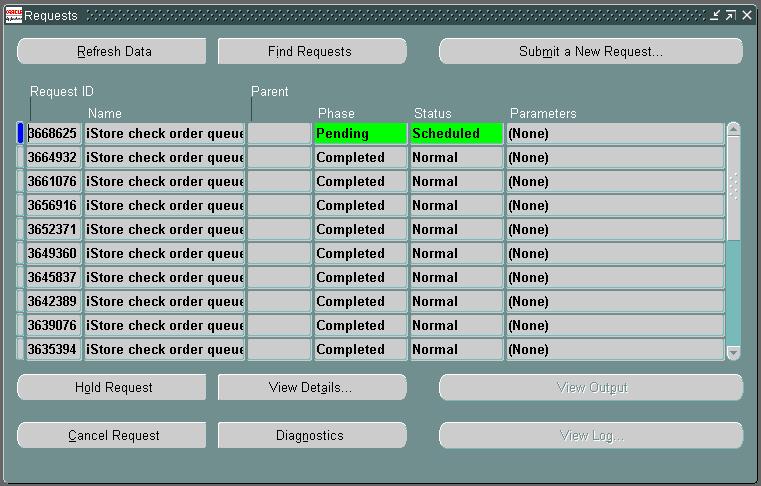
After those steps your Concurrent Program can be used and scheduled. This was what it was all about. Now you can schedule it. You can schedule it to run once or every X time. You can see from the screenshots most of the options available to you.

You can access the scheduling screens by clicking “view” -> “requests”.

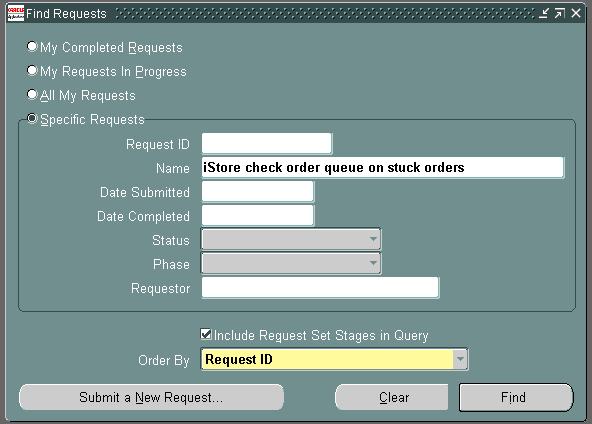
In the following screen you will be able to search for a request based upon a request ID and or one of the other fields available to you in the screen.


This will provide you with a good inside view to all your running, pending or completed requests.

The following screen is showing you the options of scheduling a request.


Saturday, January 06, 2007

YouTube.com is in trouble. Today 2 news items came out.

The first is about a Brazilian judge who decided that YouTube.com has to close if they not remove a adult video where you can watch Daniela Ciccarelli and her boyfriend Tato Malzoni making love on a Spanish beach. Google, the new owner of Youtube.com has already removed the video clip however every time they do so the YouTube community uploads a new video. The judge now decided that Google has to remove the video and make sure it cannot be replaced again.

How this will play out when Google is not complying with this can become interesting as the Google Holding is the owner of YouTube and this is a US based company and the verdict of the judge will only be valid in Brasilia.

The second problem Google is facing with YouTube is that several large production and broadcast companies are starting to sue YouTube because the copyrighted material. Several shows are published on YouTube, which are copyrighted. Because of this the companies demand a fine for every movie that is copyrighted and is published on YouTube, this could potentially lead to a total fine of a enormous amount if Google is not acting very fast now.

Tuesday, January 02, 2007

Oracle E-business suite passwords

I have already reported about a security flaw in the way Oracle is working with the passwords stored for Oracle E-business suite. The passwords are stored in an encrypted form and not as a hash value. This means that if an entered password can be compared with a encrypted password there is somehow a function that allows you to decrypt a password.

After some research I found the decryption technique to be in APPLSYS. FND_WEB_SEC as an internal function used to decrypt the encrypted passwords. TO make the function available outside the package a single line of code needs to be added to FND_WEB_SEC.

After understanding the complete way the package was working it came to my attention that you are able to decrypt all user passwords in this way. Due to the possible security risks for companies and the possible difficulties this can cause for SOX (Sarbanes-Oxley) compliant companies I informed CERT and the Dutch CERT. CERT.org responded in a quick and good way. I received a ticket number and have been updated about all communication between CERT and Oracle. The Dutch version of CERT however informed me that they would contact Oracle and requested me to remove the information from my weblog. This was the only communication I ever received from the Dutch CERT.

CERT.org have been keeping me up-to-date and finally responded that they would NOT send out a warning as there is a rather high level of access needed to the system to make the change to the FND_WEB_SEC package. I can agree on this as we are talking from a production system point of view, however the exploit becomes more scary when you think about a development environment cloned from a production environment.

In this case a lot of developers will have the access rights to do so and will be able to lookup passwords and use this in the production environment. This is to say if the passwords are not reset. As most companies are unaware of this exploit, resetting the passwords is not a step taken in the cloning process of a production environment to a development environment.

Even do, I understand the standpoint of CERT.org however I do not understand the standpoint of Oracle who identified this as a very minor glitch in there security module. Personally I think this is a lot more than a minor glitch. Personally I think the complete security model is setup wrongly from the beginning by storing an encrypted password instead of a password hash value.

If some people like to gain some more insight in the way the security problem is working I have posted some code on my website terminalcult.org.

I have a uploaded a query which enables you to decrypt a password. And I created a Oracle function which will do the same, the function has some more details in it to start understanding the way the system works.

Sunday, December 31, 2006

Patent Google? Use Google Patent.

When you are trying to make something it can be useful to take a look at what others have done before you. Which problems did they encounter and what is the solution they used. This is not patent fraud or something like it, it is making use of the knowledge available to the public. Patent offices are a goldmine for inventers and engineers the problem for a long time was that if you wanted something from the patent office you needed to know what you wanted.

You had to go to the patent office counter and requested a copy of the documents; this was making it somewhat more difficult to find what you wanted to know. Some patent offices did give you access to the archives where you could spend your days reading document after document. Some patent offices even started to provide you the knowledge via the Internet and now Google is catching up by launching a Google patent search engine where you can search for the complete patent documents.

Beside the fact that you could learn a lot that can help you develop a new product it can also be good fun to read some of the patents for some strange products, or finally find out why they in the name of God created the thing as it is………

Robots to Crawl Under the City

I have a new Slashdot posting on my name. Please read the original posting here:

"Robots will crawl tubes in a short while to investigate power cables running in the tubes to make sure they are still undamaged or in need for a repair. The Robotic Cable Inspection System is developed by Alexander Mamishev, an assistant professor of electrical engineering at the University of Washington. Making use of infrared thermal analysis and acoustic partial discharge analysis, the robot will be checking mile after mile of cable while crawling his way in the tubes."

You can find the posting by using this deeplink to Slashdot.

Marklin: Sun train.


I have already reported several times about the Sun Microsystems Project Blackbox. Now there is something new, Project Blackbox mini mini. Marklin created a scale model freight train with a Project Blackbox shipping container.

You can see more pictures on the this flickr link. More photo’s from the real Project Blackbox can be found on the images website of Sun and for more information about Project Blackbox
You can refer to the Sun project website.