The personal view on the IT world of Johan Louwers, specially focusing on Oracle technology, Linux and UNIX technology, programming languages and all kinds of nice and cool things happening in the IT world.
When your Exadata is deployed it is by default equipped with a number of standard usernames and passwords. By default all root SSH keys and user accounts will be disabled, however, a number of accounts will be open and will have the standard passwords. Good practice dictates that all standard passwords should be changed directly to ensure that nobody can misuse this and make use of the default passwords. As a quick checklist you can find the default accounts and passwords that will be enabled below and you should ensure they are closed.
Database Server:
root/welcome1
oracle/welcome1
grid/welcome1
grub/sos1Exadata
Exadata Storage Servers:
root/welcome1
celladmin/welcome1
cellmonitor/welcome1
InfiniBand switches:
root/welcome1
nm2user/changeme
Ethernet switches:
admin/welcome1
Power distribution units (PDUs):
admin/welcome1
root/welcome1
Database server ILOMs:
root/welcome1
Exadata Storage Server ILOMs:
root/welcome1
InfiniBand ILOMs:
ilom-admin/ilom-admin
ilom-operator/ilom-operator
Keyboard, video, mouse (KVM):
admin/welcome1
Keeping the default passwords in use is, from a security point of view, very unwise decission and this should be changed as soon as possible. When not done the changes an attacker can gain access to your Exadata machine is increasing enormously. In many companies a default process for resetting passwords is in place for more common servers, however, Exadata servers are not implemented by the hunderds a year in a single company so processes might not always include them. Due to this it is an extra point of attention for administrators and security officers.
Oracle database has, already from release 11G the option to use Smart Flash Cache. What Smart Flash Cache enables you to do is to extend the SGA buffer cache size of your database without the need to extend your memory in your server but rather use level 2 caching options. For this you can use, for example, PCIe flash cache cards like the Sun Flash Accelerator F20 PCIe Card which is shipping from Oracle. However, other vendors do also manufactur cards that can be used to make use of this.
The below image shows what happens in essence when you are using the Oracle database Smart Flash Cache options.
When a block is retrieved from the storage it is stored within the buffer cache of the system global area.
When using Smart Flash Cache a block is not removed from the buffer cache however is evicted to the flash cache instead.
When a block is needed again and is not available in the buffer cache in the SGA it is retrieved (if available) from the flash cache instead.
By implementing this you can avoid, up until a certain level, recurring calls to your storage device. Requesting a block from storage is slow and if this can be avoided the benefits to the performance of your database are directly visible. Next to this, and often overlooked, is the fact that this is also resulting a positive effect for other databases and applications that make use of the same shared storage device. Due to the fact that you can lower the I/O operations on your shared storage there is more room to handle the requests from other applications and due to this there can be a positive performance gain due to this indirect relation between the components.
One good thing to keep in mind is that this option is only working when your database is deployed on Oracle Linux or on Oracle Solaris.
For more information please do have a look at the presentation on this subject which is embedded below:
The standard Oracle Exadata cabinet that holds the parts of your Exadata is equipped with two independent power distribution units or PDU’s for short. This is regardless of the size of your Exadata, every size Exadata contains two independent PDU’s. The PDU’s are not specifically designed for the Exadata and are standard Sun Rack II Power Distribution Units who are generally available. In general the PDU’s are not given that much attention by administrators and it is something that is “just there”. There are however a number of important things to note about the PDU’s.
First important thing to note about the Exadata PDU’s is that they are more intelligent than your average Power Distribution Unit. During a standard deployment the PDU’s are connected to the Exadata management network. The Exadata management network is used to connect all Exadata components to your existing management network. For example your ILOM, switches and also your PDU’s to the management network.
This means that you have a power distribution unit that is connected to your network and that it is not a pure “dumb” device. You can actually connect to the device. This however introduces an “issue” that this can also be misused. An often overlooked part after the initial deployment is that the PDU is equipped with a default login and for security reasons you have to change this. In line with the Oracle documentation you need to undertake the following steps to change the PDU password and add potentially additional user accounts for the PDU with a maximum up to five users. The original instructions can be found in the Oracle Exadata Database Machine Owner's Guide 12c Release 1 (E50467-01).
The default account user for the power distribution unit (PDU) is admin. The following procedure describes how to change the password for the PDU:
Use a Web browser to access the PDU metering unit by entering the IP address for the unit in the address line of the browser. The Current Measurement page appears.
Click Network Configuration in the upper left of the page.
Log in as the admin user on the PDU metering unit.
Locate the Admin/User fields. Only letters and numbers are allowed for user names and passwords.
Enter up to five users and passwords in the Admin/Users fields.
Designate each user to be either an administrator or user.
Click Submit to set the users and passwords.
As stated, the PDU is connected to the Exadata management network and you can actively connect to it. You can use SNMP for this or you can use the webinterface. An example of such a webinterface page from a standard PDU can be seen below.
However, as it is in the strategy of Oracle to use Oracle Enterprise Manager to be the central management and monitoring tool for all parts of a landscape you can also add a PDU monitoring plugin to Oracle Enterprise Manager to monitor your Exadata Power Distribution Unit.
Need to check something in the Oracle Exadata documentation, not an issue, you can find all the documentation on the machine itself. Connect to the storage cell and check /usr/share/doc/oracle/Exadata. This works fine with the minor disadvantage that you need to purchase an Exadata machine to satisfy the prerequisite. Purchasing an exadata to be able to read some documentation might not be in everyone his budget, however, there is a little escape to still be able to download the documentation.
You can login to metalink and download patch 10386736. Patch 10386736 contains the full set of documentation. The current release of the patch dated 08-JAN-2014 contains the following Exadata documentation:
Exadata X3-8b Hardware documentation
Exadata X4-2 Eighth Rack documentation
Exadata X4-2 Full Rack documentation
Exadata X4-2 Half Rack documentation
Exadata X4-2 Hardware documentation
Exadata X4-2 Quarter Rack documentation
Meaning, if you are need to read up on the documentation and you have not downloaded the documentation from the Exadata storage cell to your workstation however you do want to have a look, patch 10386736 will be your solution and will provide you the latest version of all documentation.
When looking at the Oracle Exadata architecture it shows a couple of things that ensures that the Exadata Database machine can provide the performance that it is known for. Numerous design decisions are note worthy however function shipping is most likely one that is the most ingenuous and is currently only available on Oracle hardware and cannot be reproduced to other hardware platforms. We do see other companies then Oracle who are building hardware platforms that are capable or providing extreme performance however non of them are able to implement the function shipping in a manner that Oracle is capable of doing.
Main reason for this is that Oracle both owns the proprietary rights on the software and the hardware included in the Exadata platform. Function shipping is, simply put, moving SQL instructions from the database nodes to the storage nodes. In the below diagram you see a common way of deploying a database in combination with the storage, which in this case is a storage appliance however this could also be local storage on the database server.
If we, for example, need to execute a select statement on the table "TBL_SALE" and retrieve all records where the "country_of_sale" is "NL" the database will retrieve all data which is in "TBL_SALE" fro the storage and when it retrieves this it will filter on "country_of_sale" and finally only show the records where this contains "NL".
In essence there is nothing wrong with this mechanism, the issue however is two folded. The first issue is that if your table is large (multi terabyte) all this data has to be moved from your storage appliance to your database instance. This can result in a serious performance loss. The second issue is that the CPU's that are busy with (A) handling all the incoming data and (B) sorting this data to verify if the "country_of_sale" equals "NL" are unable to do any other tasks.
When we look at the way the Exadata machine is developed we have a model as shown below which will mitigate against the performance loss as described above.
In the above diagram, as we execute the same query as we do on a traditional database setup. the function shipping comes into play. Instead of requesting all data from the table to be send to your database engine Oracle makes use of the function shipping principal to send the majority of the SQL execution to the Exadata storage cell. The major benefit of this that, in our example case, not the entire multi terabyte table needs to be shipped from the storage layer to the database layer. The SQL statement parts that can be executed on the storage cell will be executed right there and only the rows that satisfy the SQL select statement.
By using this function shipping the system is not providing traditional block serving services to the database but rather, in a smart way, providing options to only transfer the applicable rows and records from the storage to the database. This limits the load on the CPU's on the database server and limits the bandwidth usage between the database server and the storage appliance.
Reason that this is only available on Oracle hardware in combination with the Oracle database is that Oracle build both the hardware and the software. Due to this Oracle is able to place propriatary code on the storage cell layer wich can communicate with the database instance.
To achieve this The database servers and Exadata Storage Server Software communicate using the iDB (Intelligent DataBase) protocol. iDB is implemented in the database kernel and transparently maps database operations to Exadata-enhanced operations. iDB implements a function shipping architecture in addition to the traditional data block shipping provided by the database. iDB is used to ship SQL operations down to the Exadata cells for execution and to return query result sets to the database kernel. Instead of returning database blocks, Exadata cells return only the rows and columns that satisfy the SQL query. Like existing I/O protocols, iDB can also directly read and write ranges of bytes to and from disk so when offload processing is not possible Exadata operates like a traditional storage device for the Oracle Database. But when feasible, the intelligence in the database kernel enables, for example, table scans to be passed down to execute on the Exadata Storage Server so only requested data is returned to the database server.
The Oracle Exadata database machine is known for a lot of features, however, one of the more overlooked features is the ability to make use of some of the hardware accelerated cryptographic features that come with the Intel processors that are in the Exadata storage cells. The Exadata X4-2 is equipped with Intel Xeon E5-2697 v2 processors who do have the AES-NI Intel data protection technology build in to them.
"Advanced Encryption Standard New Instructions (AES-NI) are a set of instructions that enable fast and secure data encryption and decryption. AES-NI are valuable for a wide range of cryptographic applications, for example: applications that perform bulk encryption/decryption, authentication, random number generation, and authenticated encryption."
When there is a need to ensure encryption of data on an Exadata platform you can make use of the Oracle Advanced Security feature Transparent Data Encryption. The Transparent Data Encryption is also extended to the Smart Flash Cache and Hybrid Columnar Compression parts of the Exadata to ensure that there is a full encrypted storage of your data. When doing encryption in a standard way with processors that are unable to directly work with cryptography in the processor itself it might be a performance degradation, due to the fact that the Exadata platform makes use of processors that have AES-NI build in this is no longer an issue.
What Oracle Transparent Data Encryption is doing is protecting your data against data theft on a storage level. Your data files will have to be stored somewhere on a data storage device, in the case of an Exadata these are the storage cells in your exadata. A commonly overlooked fact is that someone could potentially steel those files directly from storage or when they are moved to a backup device.
Transparent data encryption stores all data on storage in an encrypted manner. This however, can be a hughe performance gain when done on non-optimized processors. Due to the fact that Intel has AES-NI Intel data protection technology build in to the processors directly a number of additional layers are removed from the processes that would otherwise be used to encrypt and decrypt the data coming from disk before it can be used by the database.
When using a database to store data it is in some cases needed or desired to replicate the full set of data or a subset of the data to another database. In some cases this is not the same type of database which can complicate things. In many cases companies decide to create a custom build export, move and import routine. Even though this works in general there are numerous solutions that will do this task for you.
Several vendors do provide solutions to synchronize data between databases from different vendors. For architects known to the Oracle portfolio a known solution is making use of Oracle Goldengate. Less known are the solutions from Attunity. A solution for syncronizing data from a source to a target database which do not have to be from the same vendor is provided in the form Attunity Replicate. One of the big advantages from Attunity Replicate is that it is not needed to have a direct SQL connect between the source and the target system, this can be extreme valuable in cases where you might experience a lot of latency and the replication will not have to be (near) real-time.
In the below video is a short demo given on how to setup a replication of data between a Microsoft SQL server and an Oracle database by making use of Attunity Replicate.
While social media is just a fun way of interacting for some people it is big business for a lot of companies. For some people it is big business because the are in the business of mining data and interpretation data so it can be used for other purposes within companies. For other companies it is one of the prime channels for exposure and brand building. While social media is relative new it has extremely quickly become of vital importance and is not something that can be ignored by a large portion of the enterprises and even small and medium businesses. One of the things to keep in mind however is that not every social media platform might be the right one for your business.
I have already shared some blogposts which tap into the differences per social media platform and also what king of content is used on which platform in the best manner to grow your brand. Recently Hassan Bawab from Magic Logix released the below infographic on the do's and dont's per social media and what it can mean for your brand exposure and building your digital marketing strategy.
To put things in a bit other fashion I have adopted the information from the infographic and included it in the below table:
Circles & communities allow you to target your messages to groups of prospective clients & customers, rather than having them generalized for entire online market.
A reported 105 million unique visitors per month equates to a large possibility of exposure for your brand.
Studies show that traffic from Google+ to sites that have a +1 button is 3.5x greater than traffic from Google+ to sites without the +1 button.
Controversy exists of whether or not +1's affect the search rankings, but overall this network shows up high on SERP's and provides valuable backlinks as well.
Better for informational / educational purposes. however, it can be used to reply to queries about specific customer messages.
The largest power point sharing community, good presentations can be equal broad exposure for your brand.
With 60 million monthly visitors at a page rank of 8,130M page views, there is plenty of potential to draw people to your site.
Search engines include "notes" text, so properly optimized presentations are hue. Also grate for leads and referral traffic.
3
The above information might help you in creating a social media strategy and decide on which social media you will focus the most. as you can see an additional column is added to show some sort of ranking. when developing a strategy to promote your company it is good to keep the above in mind and also take into account which target group is using which social network. If you for example are in to car parts then Pinterest might not be your first choice as this social network is dominated by women and not men who are most likely your target audience. however, if you resell fashion, then Pinterest might be very interesting to you.
In the era of big data and the massive collection of data by corporations there is a growing need for scalable and affordable ways of storing all data and processing data on large scale. For some of this data, which might not be that mission critical to your operations or is not that confidential a solution might be available in the cloud. More and more cloud companies do provide the option to use cloud based databases for massive data storage or in the case of Amazon Redshift a complete data warehouse service.
What Amazon Redshift in essence provide is a large scale cloud data platform based upon a columnar storage principle and which is accessible via standard JDBC and ODBC and where you can execute standard SQL commands. Amazon Redshift is an tailored implementation of the ParAccel platform. This means you can connect your standard business intelligence tooling to it to work with Amazon Redshift.
For initial loading Amazon is offering a number of options, for example, you can load data from Amazon S3, Amazon DynamoDB or AWS Data Pipeline. Next to this numerous other ways, including SQL style insert batches, can be used to load your initial data into Amazon Redshift.
Even though I do not think it is a good idea to have a cloud only and by default strategy as some companies try to implement it can be a good strategy for some of your systems and some of your data. Next to the fact that you have to think about how to manage data and systems in the cloud and have to realize that there are some implications that are good and some that are bad there is also the legal side of storing your data in the cloud. This legal side might be facing some added complexity with the upcoming introduction of the European union data protection reform which will become active somewhere in 2014.
However, in the cases where you will have the option to store your data in the cloud and you are confortable with it then Amazon Redshift is a very valid choice for massive data storage for data warehousing. Amazon has provided some fairly acceptable security measures for non confidential data. For data security Amazon is currently encrypting every data block with AES-256 which is considered fairly secure even though a cryptanalysis related-key attack vulnerability has been discovered by Alex Biryukov and Dmitry Khovratovich. To speed the encryption and decryption process up Amazon is using hardware accelerated encryption to ensure this layer of security is not impacting performance (to much).
On the Amazon website a number of BI solutions have been outlined to be compatible with Amazon Redshift and should be able to connect to it to provide BI capabilities. The products currently listed and stated to be able to connect to Amazon Redshift are; Actian, Actuate, Birst, Chartio, Dundas, Infor, Jaspersoft, Jreport, Logi Analytics, Looker, Microstrategy, Pentaho, Redrock BI, SiSense and Tableau. All those companies provide software that is capable of using the Amazon Redshift platform to do Business Intelligence on.
As an consultancy and implementation partner Amazon is stating Capgemini to be a preferred partner with the following quotation from Capgemini on the Amazon website; "We’re impressed with Amazon Redshift's ease of implementation, scalability to meet virtually any price point, and ability to handle the toughest big data and predictive analytics demands of our clients. In the era of Big Data and advanced analytics, we see Amazon Redshift and other AWS services, like Amazon Elastic MapReduce, as vital additions to the solutions and service offerings we provide".
A less known fact, or rather an overlooked fact, is that next to the above mentioned products you can essentially connect all BI tools to Amazon Redshift while keeping your BI processing platform on premise or somewhere in the cloud and you are NOT bound by the mentioned BI vendors that Amazon is stating. For example, it is very well possible to connect your Oracle OBIEE implementation to Amazon Redshift.
The above image comes from the rittmanmead.com website who have some interesting articles on OBIEE and how you can connect them to numerous datasources including the Amazon Redshift implementation. With Oracle OBIEE you are not bound to use a Oracle database and you can still use all the features of OBIEE.
The internet has been growing at a rapid speed which was most likely not foreseen by a lot of people in the beginning. When Tim Berners-Lee added HTML and HTTP to the internet mix and by doing so opened the possibilities for the world wide web as we know it today he most likely was also not foreseeing what this would become, not even in his most wildest dreams.
As we are now becoming more and more used to the daily influence of the internet and the possibilities that it is offering us we are also trying to find ways on how to improve to the current state of it. We have had the web2.0 revolution which came down to a more social and a more interactive internet where people could more easily add to the content instead of only consuming it as a reader of web-pages. Many see the next big paradigm shift for the internet in the Semantic Web. The idea of the Semantic Web includes a lot of components from open-data, linked data, micro-formats and the internet of things / the internet of everything till big-data concepts. It all comes down to how we think about data and how data will play a role in the next version of the web.
In the below video you see what the vision from Tim Brenners-Lee is on the next version of the internet which he posed during one of his talks at TED.
What it comes down to is the desire to provide data in an open format. Not necessarily in a nice and flashy website or a closed website however rather in the pure and raw format. This in an open format like XML or any other usable format.
By unlocking this data there will be directly involved the unlocking the potential of a lot of new options. When people do have access to raw data you can create new applications and come to interesting insights. currently the most data is still in closed silo's and not accessible to the public or not accessible in an open way that you can use it in a way you can build new applications around it. When the world starts with adopting the open-data model and the linked data model there will be a sprawl of new options coming to the public.
Even though all the above mentioned things are coming our way and will change the way the internet is used and seen by the public one important architectural part is missing in my opinion, or rather, is not given the attention it deserves. The missing, or rather under appreciated part is the role that push interfaces and API's will play in this new revolution. If we look at many of the new solutions, models and formats they are all based, or primarily based, upon a pull architecture.
If you draw a high level architectural representation of the current state in which applications are commonly are developed you will get something similar like the drawing below.
The custom application could for example be a web application that tracks flight information from a major airport and shows this to visitors of the website. The website itself is represented as the "Presentation layer" in the above diagram. Every time someone is logging in to the website the code will query for the most recent flights in the local database. However, to ensure that the local database contains this information it needs to be filled with data that comes from the "data owner". What you commonly see is that there is a scheduled program to download the basic information from the "data owner" data API and it is stored in the local database. The moment a user clicks on a flight the web application code will do a "online" query to the "data owner" to get the more detailed and latest information about this specific flight.
In essence there is nothing wrong with this model and it is serving its purpose. However there are more and better solutions to do this which makes the development much more easy and ensures that applications are becoming faster, less prone to issues and less resource intensive on both the "custom application" side as well as the "data owner" side.
A more favorable way of doing this is by making use of a push API rather then a pull API. In the below diagram the same solution is shown however no making use of a push API initiated by the data owner.
The implementation of this model makes a lot of sense as it is removing a lot of unneeded communication between the customer application(s) and the data owner. Also missing an update is less likely to happen and new information, in our example flight information, is in real-time available to all who custom applications that have subscribed to the push interface from the data owner.
In the above implementation, as soon as a new flight is known at the data owner it will send out a message to all the subscribed applications. By doing so the data owner knows that all the other applications are now aware of the new flight and might, if needed, query additional information via the "direct remote data access" method to the more traditional data access API. In some cases the real-time push API will remove the need for a more traditional API however in most cases there will still be a need for this.
The hurdle for implementing this model is the need to develop standardization for communication between the data owner and the custom applications. Ideally the communication between both parties is arranged based upon the HTTP protocol and JSON or XML messages are exchanged between the 2 parties as shown in the image below.
From a technical point of view it is not hard to implement the communication from both the "data owner" side for a push data API nor is it for the receiving side complicated to create a data update receiver who will receive and process the data send by the data owner.
The biggest
hurdle in this process is to ensure that the construction of the message is
correct and contains all the needed information that the receiver of the receivers
might need and that this is done in a functional format that is not only for a
single receiving application usable but for a large set of external
applications. If we take for example a look at the work done in the field of ontology
for annotating offerings and other aspects of e-commerce on the Web by GoodRelations or the work done by schema.org you will see that developing a good standard is
something that is not to be thought of lightly. However the below illustration might
show the need for such standardization of message formats on both a more functional
level and a technical level.
Commonly a custom application, for example a web portal showing flight information, is not making use of a single source. If, for example, you like to build a web portal showing all the incoming and outgoing flights in real-time or near real-time for the city of London you have to work with 11 different data providers. London is having ten "normal" airports, Luton, Stansted, Northolt, Stapleford, Heathrow, London city, Biggin Hill, Blackbushe, Farnborough and Gatwick. They also have a helicopter only airport named Battersea.
From a technical point of view it would be a great benefit if all those airports do make use of the same way of providing a push API interface to all push the information in the same manner. This way the developers of the custom applications that will connect to it will only have to develop a single data update receiver and simply subscribe to all the 11 airport push interfaces instead of developing 11 different receivers. Next to this the data providers, in this case the airports, can make use of an already developed standard data format and can potentially decide that they will develop a push interface together so they can split costs.
From a functional point of view a standard makes sense because you will know exactly what data you will get and which format. From a functional point of view this is not the technical format but rather the functional format. For example, if the data owner is also sending out weather information per flight, it would be good if all data owners do this in the same manner and all the information is in the same functional format. Meaning, temperature is for all data owners in Celsius or it is for all data owners, who comply to the standard, in Fahrenheit. This way you always know from a functional point of view what the data means and how to interpret this.
In conclusion, push API implementations will fuel the next generation of the internet in my mind and they will ensure that the web becomes (even) more real-time and data rich. The flow of data will help sprawl new initiatives and will help create new companies and great projects. For this however there will be a need to ensure that standards will be developed, not only on a technical implementation level, however even more important on a functional level where the standards will define which information in which format will be provided to the data consumers.
For all good reasons a more agile way of development is often selected when creating a new solution. Please do note, I am not a believer of agile being the silver bullet to all development work, I do feel that the more traditional way of development is in some cases much better then an agile way of doing things. However, agile development is in some cases great and one of the things that is also great within the agile development way of doing things is the fact you will be working very close to the customer / end-user. I have learned that while doing agile development with a end-user sitting next to you it can be very beneficial to be able to draw up quickly something. The art of creating a very quick prototype in the form of a mockup / wireframe drawing can make things really quickly clear to all parties involved.
Now, the things is, what to select as a tool for doing things like this? When you start searching the internet for tools like this there is a large variety of things you can select from. Some of them I have tested and used in projects both for Capgemini as well as private and opensource projects. Below are some that you might want to give a look.
Keynotopia
Keynotopia is essentially an extension on your favorite applications you already have on your workstation and build a design with it quickly. You can add Keynotopia to Microsoft Powerpoint, Apple Keynote or OpenOffice. The great thing about Keynotopia is that you can safe the design you made as a clickable PDF and due to the fact all images are vector images it will scale to your devive and give the person who is testing your design the idea that it is really an application. Best of all, it is free and you can download it from the Keynotopia website.
balsamiq
Balsamiq is actually the first tool of this kind I used ever. Primary reason for me to use balsamiq was that it was, at that moment, the only tool that was available for Linux and which did the job I wanted. One of the cool things about balsamiq is that it uses an "art style" that clearly shows that it is a prototype / mockup. You do not have to explain to anyone that this is just a quick thought drawing you are working on and that the product itself is not available yet.
moqups.com
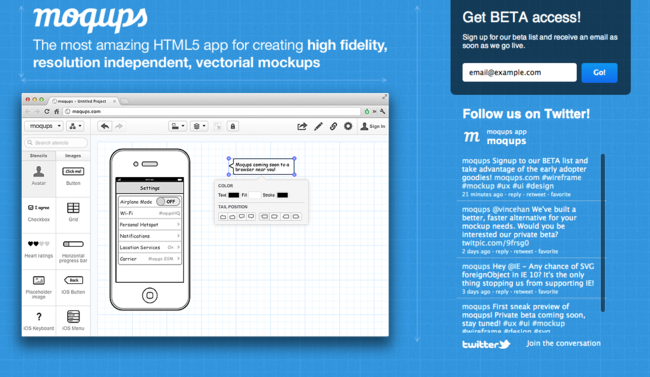
moqups.com is an online alternative for those who are always on the move. When you are shifting a lot between workstations and you do need a solution to do your wireframe and mockup work this can be a very good alternative. This is however a payed service while you have some great free alternatives that you need to install on your workstation. Sharing between workstations is always an option with for example dropbox or Google Drive.
Pencil project
Pencil project is a great, and above all, open-source project which has the big benefit that it is availabel for ALL platforms. This is especially great when you are working in a team where some are using Linux, some Mac OS and some still do tend to stay with Microsoft. As Pencil can be downloaded at no costs you can have a quick adoption witthin a team and start working all on the same wireframe / mockup designs.
Microsoft Sketchflow
Microsoft Sketchflow is most likly one the most expensive alternatives in this list, it is part of Blend 3 and is inlcuded within Microsoft Expression Studio 3. Sketchflow is very usable when developing primarily Microsoft based solutions as it ties directly into the Microsoft development tools and is, apperently, very easy to go from first design to a first raw GUI in your development tooling. This is a very big advantages however, as stated, it is primarily focused on Microsoft driven solutions and not leaving to much room for others.
Eclipse based tools
without any doubt Eclipse is one of the most favorite development environments. Originally intended for Java developers it is now growing to all kinds of programming languages. The big benefit of Eclipse is that it is open-source and that there is a very large community of individuals and enterprises who add functionality to Eclipse. Functoinality is added in the form of plugins so you can expand you development environment and options in eclipse as you go. Included are a number of wireframe and mockup tools. The one that stands out the most is WireframeSketcher which can be downloaded from the wireframesketcher.com website.
The above outline is not to select the best tool, there is not such a thing as THE best tool as this is depending on a number of factors, for example the type of applications your are developing, the adoption within your team, the tools you are already using and so on. However, the above list is to outline and state that there are numerous tools available that can make your life easy and can help you while doing rapid prototyping and agile development work. Best thing of all, the number of free and open-source tools is also very wide and available to you.
With the release of Oracle VM Server 3.2.7 Oracle has started to ship oracle VM now also with OpenSCAP. OpenSCAP was already shipping with Oracle Linux and Oracle Solaris and is now also included in the Oracle VM server distributions. This is good news for all companies who do use Oracle VM and do have a need to tighten security.
"The Security Content Automation Protocol (SCAP) is a method for using specific standards to enable automated vulnerability management, measurement, and policy compliance evaluation (e.g., FISMA compliance). The National Vulnerability Database (NVD) is the U.S. government content repository for SCAP."
By adding the OpenSCAP implementation to Oracle VM server companies can now use the same tooling for checking against know vulnerabilities on your systems. This also makes it more easy to create a more enterprise wide approach to security checking and benchmark testing for all systems. You can now directly check your Oracle VM server installation against the SCAP messages containing CVE information.
Technology is becoming more and more one of the main supporting assets of a business. Where we could state a couple of decades ago that technology was providing a useful hand in doing the daily operations it is now one of the main assets that is driving most companies. When technology fails or is not able to or designed to provide the correct level of services to the business this has an immediate impact on operations and the survivability of companies. Due to this it becomes more and more of a vital importance that companies will look critically at what they expect from technology, how it fits in the business goals and how it will support the organization now and in the future.
To ensure that an organization knows where it is, where it needs to be heading and if it has the capabilities currently to go from where they are to where they should be or will most likely need to be in the foreseeable future it is advisable to have a moving roadmap. A moving roadmap is a continuously updated IT strategy which holds a continues self assessment and future assessment. Within this moving roadmap the steps needed to ensure services will be at levels the organization needs them to be and to ensure that the company will be keeping up with trends in the market. This is not the IT market however the market segment where the company operates in and where technological advantages and improvements can be used to keep up with the changes in the business market segment.
To be able to create a roadmap it is of importance to know where you are right now and where you need to be heading. A number of components are of importance in such a self assessment. One of those is to ensure you have a clear view on the maturity of your IT organization at this moment and at a later stage how mature your IT organization needs to be to support and keep supporting the business organization. Oracle has, as part of their IT strategies library, created a framework for maturity models. The direct intention is not purely to be used within a strategic continues updated roadmap however it can very well be used in such a roadmap.
Oracle uses the maturity model to help customers understand and create an ETS or Enterprise Technology Strategy. The ETS line of thinking is used for major changes in relation to the implementation and adoption of new or updated technology. The Oracle statement on ETS in relation to the Oracle proposed maturity model is the following:
“In order to successfully execute an ETS, an organization must identify the needed capabilities required by that ETS and measure their organization’s proficiency in each of these essential capabilities. This is the genesis for the generic Maturity Model.”
The basis of the Enterprise Technology Strategy related maturity model Oracle is using the below model.
The model is based upon both areas which are categorized based upon the organizational disciplines as well as the technology that dominates an area. The organizational disciplines which are defined in this model are; “Business & Strategy”, ”Organization”, “Governance and Project” and “Projects, Portfolios & Services”. The technology dominated areas are; “Architecture”, “Infrastructure”, “information” and “Operations, Administration & Management”.
Within the Oracle maturity model framework Oracle has given the following meaning to the specific area’s;
Business & Strategy
Contains capabilities that provide the high-level constructs that allow the Enterprise Technology Strategy initiative to proceed. This includes such things as business motivation, expected benefits, guiding principles, expected costs, funding model, etc.
Organization Contains capabilities concerning the development of corporate competency around Enterprise Technology Strategy including the organizational structure and skills development.
Governance Contains capabilities concerning the governance structures and processes that support and guide the Enterprise Technology Strategy efforts. Maturity and adoption of an adequate amount of governance is a leading indicator of the overall Enterprise Technology Strategy success.
Projects, Portfolios & Services
Contains capabilities concerning the planning (portfolio management) and building (engineering) of applications and services that are part of the Enterprise Technology Strategy initiative.
Operations, Administration & Management Contains capabilities concerning the post deployment aspects of solutions based on the Enterprise Technology Strategy i.e. the Operations, Administration, and Management aspects of the Enterprise Technology Strategy.
Information Contains capabilities concerning the information aspects of the Enterprise Technology Strategy. This includes shared data models, message formats and schemas, data ownership, data management, content management, etc.
Infrastructure Contains capabilities concerning the infrastructure and tools that provide the technical foundation for the Enterprise Technology Strategy initiative.
Architecture Contains capabilities concerning the definitions of the overall architecture and guidelines for various practitioners to ensure adherence to the architecture.
As can be seen from the above descriptions of the areas in the maturity model this is a model that is originally created and still dominated from an Enterprise Technology Strategy point of thinking. However, the model itself is very much usable for other self assessment tasks. The areas that have been selected by Oracle are giving a real good representation on a number of key area’s. The difficulty during every initial setup of a maturity model is which key performance indicators will you be including in the main area’s.
For example, if we take the architecture area it states as a description “Contains capabilities concerning the definitions of the overall architecture and guidelines for various practitioners to ensure adherence to the architecture”. The challenging task when building a maturity model is to find the sub parts which will cover this description in measurable KPI’s and giving each KPI a certain weight. When given the appropriate level of thought and the appropriate level of attention throughout the organization the maturity model can become a very valuable tool to be used in ensuring you know where your IT organisation is at this moment and where it needs to be in the future to keep providing the necessary services to the business when they need it.
Already for a long time companies are trying to tackle the issue of indoor navigation. Already in 2011 I wrote a short post about the upcoming market of indoor navigation and what the people at Nokia research lab where doing is this area. Unfortunately, even though a lot of people do see a market potential in this, there is not much to report in this field and not many really adopted products or protocols have been developed by the industry. Now a new attempt to tackle the issue of indoor navigation is coming into play.
with the release of Apple IOS 7 and the software development kit Apple has introduced the option to the development community to make use of BLE or Bluetooth Low Energy.
"The iBeacon works on Low Energy Bluetooth (BLE), also known as Bluetooth 4.0 or Bluetooth Smart. In a real life scenario it would be more of a location-aware, context-aware, pervasive small wireless sensor beacon that could pinpoint your location in a store: iBeacons could send you notifications of items around you that are on sale or items you may be looking for, and it could enable payments at the point of sale (POS) where you don’t need to remove your wallet or card to make a payment. It could be a possible Near Field Communication (NFC) competitor."
Even though this technology is thought to be a pure Apple technology by some people this is a wrong assumption. iBeacons can be pruchased from a number of companies who develop them and all comply to the same standards. iBeacon is nothing more then a framework where some hardware vendors are developing the hardware beacons for. The most known developer of beacons is estimote however beacons are developed by for for example roximity.
An explanatory video from Estimote can be seen here;
The options of what can be done with the iBeacon solutions are numerous. In the above video some examples are mentioned. For example personalized prizing of items in a store which might differ from person to person based upon their membership of the stores loyalty program. Also an option is to show the number of likes for a product and product reviews.
However a large number of other options and solutions that can be created are possible, think for example indoor navigation on an airfield where someone is directed to the lounge or gate where this person should be. Also a personal plan for someone visiting an exhibition, some exhibitions can be extremely large and navigating the floors and be able to see all the vendors and conference speeches can be extremely difficult.
If you take for example the annual Oracle OpenWorld conference in the Moscone center in San Fransisco. It consists out of a number of exhibition floors with a large number of vendors and also it is a conference with a extreme large number of speeches. Getting from conference room to conference room and not missing anything can be hard. Currently visitors can select a track and they are guided and helped by a program. Adding to this program an APP that will help you get to the correct room on time and help you, for example, keep track of where all your colleagues are so you can meet up for coffee between talks would be a great addition. Oracle OpenWorld is just an example and a indoor navigation framework could be offered by the conference center owners as a service to the conference that is using their location.
A little less then a year ago Oracle completed the purchase of Acme Packet. "Acme Packet enables trusted, first-class delivery of next-generation voice, data and unified communications services and applications across IP networks for service providers and enterprises. The company's solutions are deployed by more than 1,900 service providers and enterprises globally, including 89 of world's top 100 communications companies".
By purchasing ACME Packet Oracle has extended its product portfolio extensively and create the Oracle Communications product group. The current Oracle Communications product group is shown below in overview diagram;
The current naming of the products within the Oracle Communications product group can be a bit strange for people who are used to the original naming used by ACME Packet. For them, and for people working with Oracle Communications products it can be good to have some understanding of how Oracle has grouped products in the product group and sub product groups.
In general Oracle Communications is buildup out of 4 main product groups, Hardware, Network Session Delivery and Control Infrastructure, Enterprise Communications and Network Visibility and Resource Management. The last product group, the Network Visibility and Resource Management group is divided in two separate sub groups; Oracle Communications Session Delivery Manager and Oracle Communications Session Monitor.
When looking at the Oracle Communications website the total reach of the product portfolio is a lot bigger then what you can see above and the full integration possibilities become clear. By combining the products from "pure" Oracle Communication and combining them with other products from Oracle you can build a near red-stack solution for your entire communication delivery within your enterprise or have it as your core business to end-users outside of your company.
It is a shame that this part of Oracle is overlooked and it is especially a shame that it is overlooked by a lot of the integration and solution architects who design software solutions and commonly stop where direct communication is needed between humans and we leave the computer-to-computer communication.


.jpg)